Parenting Tips in 2026
July 2026
July 2026

There are many different breathing techniques you can teaching your child and practice together. I spontaneously made one up that I've found works incredibly well, so I wanted to share it with you here.
Breathe in. As you exhale, open your mouth (like a lion's breath) and exhale with your voice on. It sounds like a sigh but deep in your register. Bonus points if you nuzzle noses together. It regulates the nervous system and is a bit goofy, which can shock a kid out of their upset enough to be able to turn back on their thinking brain. It's extra ridiculous if you're in public, but it beats a meltdown in public any day of the week!
June 2026
July 2026
This month I went to a kids' birthday party at a fire station. We learned about the trucks and the sounds and the gear.
I learned a fire safety tip that I'd never heard before, so I'm passing it along to you here.
Familiarize your child with what a firefighter looks like fully decked-out in gear. They wear a scary-looking mask that kids might run away from when they're already frightened in the event of a fire. The kids were cautioned not to run away and hide from a firefighter if we were ever in that situation.
We made a connection between wearing a costume and the mask and other coverings. This wasn't ever something that occurred to me to prepare kids for, but it's so good to get ahead of a child's potential concerns.
May 2026

If you have a child who is bouncing off the walls right when it's time to go to sleep, it's likely that they are seeking some additional sensory input.
One thing I love to do is deep pressure. This can be pushing a pillow on their back, giving big squeeze hugs, or moving a foam roller gently on their back.
My favorite, though, requires a yoga mat. Simply roll your child up like a burrito and they get tactile, proprioceptive, and vestibular input.
April 2026
I find personal finance really interesting on both the micro and macro levels. Did you ever hear, "we can't afford that?" when you were a child?
Most often, when people say that they really mean, "We're choosing not to spend our money on that." So imagine if that's actually what we said to kids??
I'd like to propose a conversation to have with your child around how you choose to spend your money, regardless of your financial situation. Teach your child to align spending with values. I often say, "We care more about experiences and we already have so many toys, so we're not going to buy another one today." I might pair that with, "we love baseball so we spent our money to watch it and enjoy our time together."
I also love calmly and neutrally explaining that when we are careless or wasteful, we end up spending our money to replace that item, rather than the fun thing we could've otherwise done. That's not exactly linear, of course, but it helps young children understand that new items don't just show up without spending money, a resource that depletes over time with purchases.
March 2026
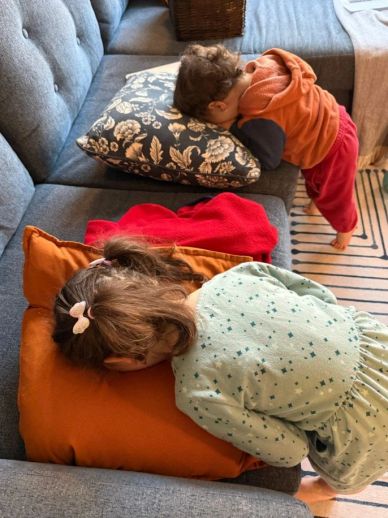
The best parenting tool I've been utilizing lately is to share what a child can do rather than what I don't want to do. You've likely heard the reframe of "walking feet" instead of "don't run!"
I'm talking here about a specific behavior I want a child to shift, because sometimes they just don't know what else is out there. They've really only been on the planet for a very short amount of time.
Recently, my daughter has decided to start screaming in order to express her upset and to attempt to self-regulate.
In a calm moment, I explained to her why the screaming hurts my head and my ears, but I understand why she'd want to scream.
I offered yelling into a pillow, got really goofy about it, role played and practiced 1,000 times and...
...she uses it on her own now!
It's not a win every time like that, but it's now a tool in her toolbox so when she's disregulated she has a more socially appropriate option.
I challenge you to think about the situations in which you might reframe what your child can do to add one more tool to their toolbox this week!
Other situations this may be useful for you:
Your child hits. You say, "you can say, stop, I don't like that. You can ask for a big hug."
Your child whines. You say, "you can say, I need help please. You can take a deep breath before talking."
It's very possible they just didn't even know these things were options. And, when you teach this strategy, we have to remember that they may need the repetition again and again and again before it sinks in. Just because you're not seeing results quickly doesn't mean it's not working.
February 2026
This month's resource is different than my typical ones -- it's not exactly to enhance your life as a parent or your child's as a learner. Instead, I wanted to shine a small light on a program that listened to and respected kids without condescension.
I've been going back through so much pertaining to my dad after his death, and I wanted to honor his work and his memory sharing about Kids America.
A radio station of the 80's, kids could dial in to chat about what was on their mind or answer cognitively challenging trivia questions about music, science, spelling, and more.
I am feeling a deep connection to my dad, over our shared passion for connecting with children on a deep, respectful level and helping them understand that what they have to say -- as well as who they are -- is important.
January 2026
January 2026
January 2026
Another heavy topic this newsletter, for another month of heaviness in the world. Thinking about the gravity of our political climate is so paralyzing, which makes trying to explain it to our kids, who we want to both protect and inform, feel near impossible.
I'm going to share just one tiny piece of the puzzle. We were walking by Target this week, and folks were protesting outside the store. In the absolute freezing cold, my daughter and I pulled over on the sidewalk so she could watch what was happening.
I'm sharing our dialogue to highlight a few things.
1) Only answer the question asked.
2) State things neutrally and factually correctly.
3) Appreciate your child's curiosity to keep the door open for further questions in the future.
4) Remind them they are safe
Parenting Tips in 2025
December 2025
December 2025
This month, I had the very challenging experiences of not only losing a parent, but also figuring out how to communicate it to my 4 and 2 year olds. I did a ton of research for myself and I hope by passing it along, it may help you in the future. You may know some of this already, either because you've experienced it, or because you know it intuitively. Here goes.
1. Speak with tangible, not abstract words.
"Grandma's heart stopped pumping blood so her body stopped working." "Grandma's passed away."
2. Compare the idea to something your child has experienced before, like seeing flowers or a houseplant wilt and die.
3. Acknowledge the sadness.
"Sometimes people cry when they miss someone. You might see people in our family more sad than you normally do."
4. Talk about what you can do: make a card or draw a picture, tell stories, look at photographs, or do an activity you both loved and shared.
5. Prepare for wild questions and try to answer them with facts. If you genuinely don't know, say you don't know.
6. Expect your child to bring up questions way, way later. As your child's brain develops, they may be able to process events in the past that they didn't have the cognitive maturity for months or years prior.
7. Finally, in my family when my kids ask where they were in a picture that was taken before they were born, I made up the phrase that they were "just an idea" at the time. My daughter, wisely, said that Gagu (her name for my dad) is now "just an idea." The profound and accurate nature of the statement initially left me stunned. And it is simply perfect. I hope you might use it one day and find the same solace.
November 2025
December 2025
This month I want to encourage you to think about ways to help your child become more independent (which, of course, helps you in turn.)
Problem: My child is constantly asking me, is this the right shoe for this foot?
Solution: Provide foot cutouts using cardboard, cardstock, whatever! Your child can hold the shoe up to the paper to solve their own problem.
Or...
Problem: My child asks for things like snacks, water, and the blue cup all the time.
Solution: Make items reachable for your child. Yes, there will be spills and messes, but (in my opinion) that's so much better than needing to reach things for them. And it helps them learn to clean up any mess that they make!
October 2025

I imagine you've heard someone say this phrase before: "you get what you get and you don't get upset."
It's meant to acknowledge that a child might not get what they want, but they don't have to fuss too much about it. So let's unpack that a bit: it's okay to not like your popsicle flavor but please squash down your feelings to make me more comfortable.
An alternative, that I proudly have to attribute to my daughter is, "you get what you get and you might get upset."
You might not mind too much. Or you might be devastated. You're still not having a choice here, but whatever emotions come up are welcomed and I, as your adult, can tolerate and hold space for them all.
September 2025

I mentioned last month that I wrote into Care and Feeding to crowdsource a parenting question and the community did not disappoint. Of course, people started fighting with each other in the comments section about a tangent, but I got all of the answers I needed. My question was: how do I explain to my child that my spouse and I sleep in the same bed, while kids have to sleep in their own beds? I was so pleasantly surprised with some great suggestions. Do you have anything to add?
August 2025
August 2025
I'd like to share language that I use every single day. "I'll keep this safe until you get back."
Here's how it works: it's time to use the bathroom and your child is sitting in a chair drawing. In their head, they're likely thinking, "I don't want to go because my brother is going to take this seat that I want. He's also going to destroy my picture."
By ensuring that their spot is secure/no one will touch their materials, you'll get much better buy-in for the transition.
Sometimes it's when a tutoring session is over: "I'll keep this lego structure safe until you come back" helps some kids feel okay to leave knowing it'll be there for them.
And then the crucial piece is being consistent every. single. time. Otherwise you lose all credibility. Sometimes, I'll even play it up if there's another adult around to say to them, "please don't sit in her chair because we're going to read one book and then come right back." If you try it, let me know how it goes!
July 2025
August 2025
I was thrilled to hear from many of you that the parent regulation strategy, while absurd, was helpful and worked!!
You know I've got more where that came from. Let me paint the picture: it's the middle of July and it is swampy and hot. You've been carrying your child because he's too tired to walk and your body is so overstimulated and that means that you can't think straight or parent well. Here's what I want you to try:
1. Robot talk: This. Means. Talk. Like. A. Robot. Beep boop.
When you're giving directions to your children, when you've been asked a question one too many times, etc. You'll look ridiculous but it will reset you and help you connect with your children, which will in turn, re-regulate you both.
2. Similarly, I'm going to ask you to be ridiculous in public again. This time it's turning into Monster Mommy. Or Monster Daddy. Or Monster Liz (insert your name, though!) You are going to act like you are a monster about to eat up your child. Or stomp on them (haha). Whatever you do, you're going to growl, and do that weird "I'm going to get you" move where you saunter side to side. Something like, "I'm Monster Mom and I am going to explode because we need to get ready for bed. Rooaaaaarrrr!"
June 2025
I don't know what your house is like, but when I'm trying to ensure everyone is ready to get out the door, it feels like herding cats through a fire drill. One kid finally gets both shoes on and then someone has to use the bathroom, or spills food all over their clothes, or, or, or...
And you know what I did this morning? I started dramatically and ridiculously singing: "I am dysregulated becauuuuse I'm meeting everyone's neeeeeds but I need to sit dooowwwn." My kids were mesmerized, and I actually felt myself feeling a bit calmer. It's absurd and embarrassing but it's rooted in research to help re-regulate your nervous system. Let me know if you've used it before or give it a try (probably in your house or car -- not out in public!)
May 2025

I assume you have heard the disclaimer before: do not say "good job" to your child. (If you haven't, read the original claims from Alfie Kohn here.) It's much easier, I think, to replace language than to halt it all together, so here are a few ideas of what you could say instead:
Wow, you used so many colors here!
I see how hard you worked on this.
What did you make? Tell me about it.
Good job not only communicates that your approval is needed for an art project to be completed [cue the therapy sessions as an adult seeking consistent outside positive feedback] but it's also a conversation ender. They got the seal of approval and are ready to move on. Instead, a conversation allows for you to deepen their cognitive thinking and a moment of connection with you!
April 2025
April 2025
This one works equally well for friends, spouses, or coworkers as it does for your child. When someone is upset, try saying, "Do you want:
1) help fixing the problem?
2) or just to feel?"
The answer to that question will determine how to best respond to what the other person needs. Does this resonate with you? Sometimes I just want to be mirrored, so I can be seen and know that I'm understood. That I'm not the only one who has ever felt this way. That my perspective makes sense. At others, I have processed my feelings and really just need someone to help me grapple with a challenge or point out my blindspots.
If you go in with strategies and solutions, but your child really just wants to be reminded that it is safe to cry and be sad, here's what will likely come next. Your child's brain quite literally will not be able to process the information you're saying. Additionally, they'll be implicitly learning that their feelings are not okay and must be "fixed." (Though, we know that we can't fix people, feelings, etc no matter how much we try!) You will likely walk away feeling frustrated that your child isn't utilizing your -- very logical and helpful -- suggestions. A lose-lose all around.
Alternatively, if you respond by saying,
"I can see on your face you're sad."
"Wow, that's a really big feeling."
"I know what it feels like to be disappointed."
"This is so uncomfortable to feel frustrated."
Your child will allow the feeling to come and go, like a wave in the ocean. Try it on the adults in your life, too, and notice how it goes. When I can remember to implement this, I feel so much more connected with and supportive of those closest to me.
March 2025
April 2025
Earlier this month, I was taking the bus with my daughter and teaching her how to hold onto the pole with two hands, widen her stance, engage her muscles and be able to stand successfully on the moving city bus. She was interested in having a standing option as opposed to always having to sit on a seat.
Suddenly, the bus driver started yelling at me, "That baby needs to sit down!!" I was really unsure of how I wanted to respond and truly froze for a few seconds.
On one hand, I wanted to say, "Oh, she's okay, thank you!" On the other, it's this driver's bus and I wanted to respect her rules. Additionally, I did not want to get in some big unnecessary altercation. [Not the main point of this, but please let me know how you would've handled this situation!]
Now, imagine you and your young child are leaving a toy store and the cashier says, "Thanks! Have a great day!"
Let's think about what your child might be thinking. With little to no previous experience with this dynamic, they're not going to know to say some flavor of, "Thanks, you too!"
When we don't know how to behave in a social situation it can be paralyzing. It happens far less frequently now as adults, but when it does? Boy, does it feel brutal. Feeding your child language, at any developmental stage, of what to say in certain social scenarios can equip them with crucial tools to lower stress, feel confident, and navigate tricky situations. I wish I had had someone whisper in my ear an appropriate response to the bus driver!
February 2025
Recently, my daughter decided she was ready to get out of bed when she woke up and come in our bedroom. I am incredibly lucky (and somewhat baffled) because it took her until 3 years old to realize she had the ability, long after we turned her crib into a bed.
We bought the Hatch and implemented a new protocol that she can come upstairs when her light turns purple (a color of her choosing). She did not. My daughter understood what to do cognitively, but in the moment she just wanted to be with me. So we'd bring her back to her room and she'd stay (a win!) but cry as loud as she could with the door slightly ajar (a half win?)
The next night, we reviewed what she can do when the sun comes up if it's not time to come out of her room yet. "You can read a book, snuggle a stuffed animal, play with your toys, sing. What else might you do?" She looks up at me and says, "I can cry?"
And as I took a breath, I realize what she was confirming for me in that moment was permission to feel. What she was learning through this painful boundary was this: I have to follow the expectations but I don't have to like it. My big feelings are safe and welcomed but they won't change my outcome."
Have you found a way to hold space for your child's big, unpleasant emotions without caving into their demands? I really want to hear about them!
January 2025
"If you can't do it, I'll help you."
This is something your child has heard from adults many, many times before -- with fastening a button, pouring water into a cup or reaching something up high. Today, I want to present a different situation where this response is incredibly useful: when your child hits, acts defiantly, or refuses to comply with what you're asking.
The other day, my daughter was saying goodbye to her best friend after school. (She's 3 for context!) It was time to say goodbye and her friend went in for a hug.
She hit him right in the face.
"Why would you do that??"
"We don't hit."
"Say you're sorry."
Those are logical and common responses. But here's the thing: she knows not to hit. She doesn't know why she did it and couldn't control her impulses. She is feeling embarrassed that she hurt someone she loves.
In those moments I would handle it by saying, "You're really upset we have to say goodbye that you hit" [mirroring, putting words to her experience] and calmly noting, "I'll help you" [providing support]. Because when we are there for our children in their most unpleasant and unkind moments and when they don't know how to manage a situation themselves, they are learning that someone is always there for them to swoop in and support them.
Teaching Tips in 2026
June
June
Did you know that you can use a dry erase marker on MagnaTiles? It's a fun way to spice up learning literally anything - spelling, numeral recognition, letter identification, rhymes, you name it!
Easy set up, easy use, easy clean up!
June
June
So many of you work with kids who have ADHD and I wanted to share a reframe of how to think about getting them to do anything.
A neurotypical brain is more likely to be able to think about the positive and negative outcomes of a decision. "If I put my shoes on now, I'll get to go to the park." Or even: "If I don't get my shoe on now, mom won't take me to the park."
Kids with ADHD are much less likely to be able to use those variables alone to control impulses. Instead, try implementing the element of surprise -- change up how you do things and how you present the information. (Bonus: this works for all brains, but especially ADHD ones!) I've talked before about using a different voice (robot, operatic, whisper). You can also throw yourself on the floor dramatically and pretend you can't move until the shoes are on. You can start juggling socks. You can put socks on your hands. You can set a challenge to put shoes on before something else happens or against a countdown clock.
May 2026
April 2026
If you have a kid who is a bit more reluctant to do schoolwork over the summer, I have a small tip that can bring in some playfulness, and therefore, buy-in.
Get some wrapping paper (you don't even have to actually wrap it, just crumple it up) and put whatever you want your child to work on inside.
If all you're working on is fine motor skills, put in toys you already have and the excitement of re-opening a gift will be a thrill all on its own. If you are working on letters or sounds, grab your letter magnets or letter puzzle pieces or whatever you already have lying around. If you're working on memorizing times tables, wrap up a post-it or repurpose some recycling and write the multiplication problem to be unwrapped. It's fun, engaging, novel, and can help your child review some academics between school years.
April 2026
April 2026
A quick and easy one for rote memorization. Put something on a hand and every time you pass it, your child needs to high five it and say whatever is on it. This can be used for numeral recognition, words, shapes, a mantra reminder, etc. The movement and playfulness around it will help improve whatever you're working on memorizing!
March 2026
A quick and easy explanation for letter formation is using letters to *magically* turn into other letters. C is the easiest one -- c can become g, a, d, o, q, + e. This can be a great tool for minimizing letter reversals and for teaching new letter formation.
February 2026
The big focus right now in reading instruction is phonics. It's heavily weighted, which I'm all for! However, other skills often get brushed aside as less important, such as comprehension and vocabulary. I want to share a learning tool you can use at home to help your child infer the definition of unfamiliar words through root words.
It's akin to auditing Latin and Ancient Greek all at once. For example, if you know that words with "dict" in them meant they had to do with saying something (think: dictionary, dictation, etc), then you come across the word "verdict" when taking a test. You may not know what it means, but you know someone is saying something about something to someone. And that may be a strong enough clue to find the right answer on the assessment. Plus, it's very fun when you realize certain words are connected (did you know vocation -- with the root of voc, meaning voice -- is related to the concept of being "called to" a profession?!) I can't be the only one who geeks out about this.
January 2026
January 2026
January 2026
At this point, the excitement of New Year Resolutions have likely worn off. I challenge you to set them for your child with your child! Goals make things far more structured and provide us with some meaning. When measurable, we can also feel a sense of accomplishment and get a rush of all of those positive hormones.
I found this one from a quick search on Canva. To simplify this, there could be simply one or two goals of what you really want your child to work on. Coloring it in or using stickers can be so fun. As can coming up with some kind of celebration at the end of the week when all 7 boxes are colored in.
This teaches your child SO many executive functioning skills in the sneaky way that they don't even realize it's happening.
Teaching Tips in 2025
December 2025
Recently, I was working on glued sounds with one of my students, for example, /nk/ or /ng/. When you say a word like sink (try it now!) you open your mouth wide and fold your tongue towards the back of your throat at the bottom of your mouth. The sound comes from your nasal passage rather than from your vocal cords. One way to check is by plugging your nose and now try to say it again. (Did you do it?) You literally won't be able to make the sound but you will if you tried to make the /s/ sound.
Many kids struggle to make the correct sounds when reading the word sink because they make the typical sound for N, which is tongue behind your top teeth. (Feel the difference?) Practicing the different kinds of sounds we say when we see N will help.
Also, often kids will add a /g/ at the end of a word like hang. You'll hear a pronounced /g/ at the end of the word. It's very helpful to identify the differences as pre-readers and when working through these words!
November 2025
One of the best ways to make information really stick is combining joy and silliness with real life applications. This example is very specific to one piece of content, but please extrapolate the idea to anything your child is working on. The letters ow and the letters ou often tell us to say the OW sound, as in you got hurt. Writing them on bandaids and wearing them when you have an actual cut or scrape will help reinforce the spelling pattern the next time your child sees it in a book! (Bonus info: not sure when to use each spelling pattern? Ou is often found in the middle of words, like mouth and ow is often found at the end of words like cow!)
October 2025
In a conversation with a parent this week, he asked me what he can do to deepen his child's learning. He said that test scores are strong but he wants to make sure his son is being challenged thoughtfully and intentionally.
Here's what I told him. The best question to ask over and over and over: "What makes you say that? How do you know? How did you get to that answer?"
If you can prompt your child to share about their thought process, you can help them access higher cognitive levels and eventually reach them on their own.
September 2025
I love to put a digital book on my computer, or a math worksheet, or an image I'm looking at with a student, and Airplay it onto the television. It has this magical, larger-than-life feel like we're watching TV but really just working on vowel sounds. Reading a book "on tv" is just goofy and novel enough to spice up any reading time.
August 2025

The teaching tool that I use most frequently is really a broader concept: adapting materials to whatever my student is working on. The best part about this is that it allows me to follow an individual child's interests, mood, & energy level in the exact moment we're in. It's easy to pivot for short attention spans and let kids lead the learning format while I control the content we're working on.
Recently, that's looked like:
*playing Guess Who but with letter identification
*putting post-its with letters on magnatile pieces
*reading texts based on student interests (lately it's been sharks and whales)
*writing sentences that incorporate hilarious words like underwear
July 2025
Our brains do much better at retaining information anytime learning can be multisensory. I recently was introduced to a Buddha Board and bought one instantly. It combines the joy of watercoloring without any of the mess because it just uses water that quickly evaporates on the material. Most people probably use it just to do simple brush strokes because it's quite soothing. However, I have been using it to practice skip counting, heart words, phonics rules, and letter identification. It's fun and can be used for so many things!
June 2025
April 2025
June 2025
Perhaps in your own research you've come across the Pomodoro Method (TLDR: 25 minutes of focus, 5 minute break on repeat to be productive).
For some students, it's a focused timer of maybe 10 minutes of focus with a break. For others, it might be complete 1 book (with previews of how many pages and how much text is left, by request) and then a play break of their choosing. Regardless of what the child needs, it's always a predictable pattern of work and rest that we agree upon together.
May 2025
April 2025
June 2025
Spring break is officially in the rear view mirror and we're beginning the countdown to the end of the school year. Reading practice can get stale after being in school for so many months, so let's spice it up a bit! (No affiliate links -- just stuff I love!)
1. Whisper Phones -- these plastic "phones" that you hold up to your mouth and ear. When you read out loud, it amplifies your voice and makes reading so goofy and fun.
2. Laser Pointers -- attach these bad boys to your pointer finger, flip off the lights, get in your fort and make the pages light up one word at a time.
3. Reading Glasses -- pop the lenses out of some freebie sunglasses you got at a giveaway and suddenly they are special glasses only for reading books. Plus, they make for adorable pictures.
April 2025
April 2025
April 2025
I'm sure if I ask you how many syllables are in a word, you can answer accurately. Watermelon? [It's 4.] Table? [2.] But what actually makes a syllable a syllable?
Understanding it for yourself will help you be able to support your child's reading -- when they are reading words like cat and like thermodynamics.
The easiest tool I can share with you is to notice when your mouth opens. When you're speaking, your mouth opens when you say a vowel sound and every syllable has a vowel sound in it.
Let's give it a try (literally say it out loud):
Say electricity. You can likely tell me that has 5 syllables. But how can you help your child who can't figure that out quite yet? /ee/ /lec/ /tris/ /it/ /ee/. There may be a letter that you think of as a vowel in each syllable (remember learning "sometimes y"?)
Hold up a mirror to your mouth and you'll see when you open your mouth. Voila!
March 2025
April 2025
When working on making sounds, I find it incredibly useful to talk about what is happening in your mouth.
Many kids have a tough time discriminating between the /f/ sound, as in fall, and the /th/ sound as in this.
When you identify what is happening with your lips, tongue, teeth, and voice box, it's much easier to identify differences. You may hear kid saying "I fink it is going to snow" and not understand the error in their speech.
Looking at these images, the /f/ sound has top teeth on the bottom lip, while the /th/ sound requires the tongue being placed between the teeth. Bonus points if you hold up a mirror to your child to look at so they can connect the way their mouth feels and how it looks.
February 2025
When I'm trying to help a student recall information that involves some kind of rote memorization, I have a laminated hand that goes up on the wall somewhere you walk by every day. On it is written the thing to memorize -- it can be the quadratic equation, the number 15, or a scribble of the color blue. Every time you pass it, you high five it and say aloud the thing you are trying to internalize. It's fun, it disrupts the rhythm of activities just enough to keep stability and to keep kids on their toes, and most importantly, it works!
January 2025
If you have a child still learning to read, this one is for you. (If not, move on and I've got you next time!) When you are saying the sounds that match the alphabet letters, it is super common and counterproductive for us to add an "uhh" sound to the end.
For example, the sound for the letter B is /b/, where you close your mouth, press your lips together, and push out a small puff of air. Before I knew better, I said "buh" adding a long "uhhh" sound to the end (fancily called the schwa). When we do this, we go on to sound out a word like "bat" and we say: /buh/ /ah/ /tuh/ and it reads like this: buhatuh.
Can you hear it? Keeping your chin from dropping ensures you only say the consonant sound and helps your child go much faster from isolated sounds to blending sounds together and hearing words.We bought the Hatch and implemented a new protocol that she can come upstairs when her light turns purple (a color of her choosing). She did not. My daughter understood what to do cognitively, but in the moment she just wanted to be with me. So we'd bring her back to her room and she'd stay (a win!) but cry as loud as she could with the door slightly ajar (a half win?)
The next night, we reviewed what she can do when the sun comes up if it's not time to come out of her room yet. "You can read a book, snuggle a stuffed animal, play with your toys, sing. What else might you do?" She looks up at me and says, "I can cry?"
And as I took a breath, I realize what she was confirming for me in that moment was permission to feel. What she was learning through this painful boundary was this: I have to follow the expectations but I don't have to like it. My big feelings are safe and welcomed but they won't change my outcome."
Have you found a way to hold space for your child's big, unpleasant emotions without caving into their demands? I really want to hear about them!

Roots and Branches Education
Find engaging lessons, fun read alouds, and opportunities for rote practice.